
Oats Situation and Outlook
- Monday November 28, 2005
This analysis featured in the November 28, 2005 issue of the HGCA's MI Prospects, Volume 8, Number 11
Key points
- Tighter supplies and higher prices
- EU and UK production lower
- Smallest UK area on record
- UK net-importer for first time in almost 20 years
Declining EU oats production has resulted in a tighter supply situation this season. Prices have risen and are above those for other coarse grains. The UK harvested the smallest area on record and imports will need to increase to meet milling and possibly other demand.
A very long term trend of declining oats area and production, which stretched back to the era of working horses, appeared to have been broken in the mid-1990's. Increasing demand for oats for recreational horses and for milling for human consumption promised improved price prospects. This, together with the promotion of oats as a break crop, caused a temporary reversal in this trend. But with unfavourable oats prices over the last few seasons, output has again over the last three years declined.
EU
EU oats output is estimated by Coceral at 7.9Mt this year, 10 and 17%, respectively, below last year and 2002. All of the seven largest producing member states except Finland had smaller crops (Graph 1). All were harvested off smaller areas and for Spain output was reduced further by drought. With carry-over stocks seemingly about unchanged from a year ago, total supplies are about 900,000t lower.
continue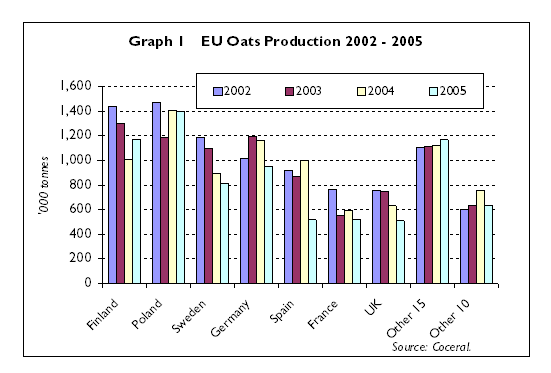 continued
This tighter EU supply situation has resulted in prices rising by €5.00 to €10.00 /t depending on location, above year ago level, whereas barley prices are generally on par with 2004 levels.
The EU provided export restitution by the end of October on 96,400t of Nordic oats which is about the same as was granted last year by that time. To date in November, however, there have been no bids. Either this signals a natural break for winter in Scandinavian export programmes, or sellers have withdrawn from the market as they assess an increase in demand from within the EU, including Spain and the UK, and lower levels of supply.
UK
The UK situation parallels that in the EU as a whole. Historically, UK oats production declined to a 1993 harvest of less than 500,000t, after which oats traded at as much as a 25% premium to feed wheat. Over the following 10 years oats production increased by 50%. While milling usage rose by rather more than 50%, growth in feed consumption was less robust and supplies were surplus to domestic requirements (Graph 2). As these surpluses had to be competitive in general offshore feed markets, prices went to a significant discount to feed wheat.
continue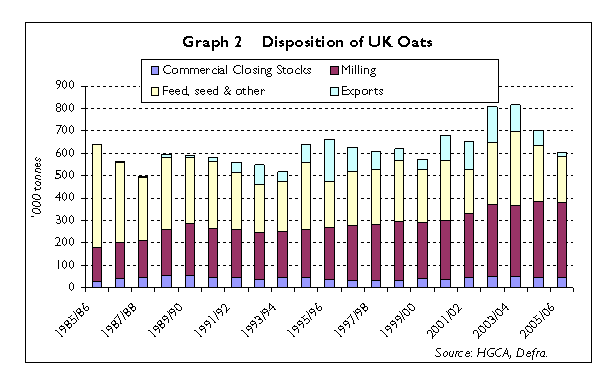 continued
Naturally this has resulted in lower production over the past few years, with prices recovering as supplies have diminished. From a one third discount to feed wheat following the 2003 harvest, they have moved to better than a 10% premium this autumn (Table 1).
continue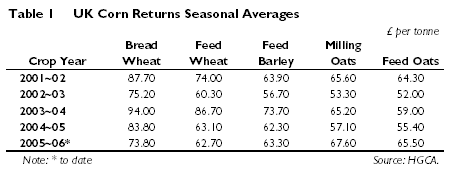 continued
This year’s UK oats area was reduced to 85,000 ha, 21% below last year and the lowest level on record. Production was 15% lower than last year at 536,000t and the smallest crop since 1993. While crop yields were relatively favourable and the quality of the crop, some light weight grain in southern England aside, was good, the lower area has resulted in a tightening of the supply balance.
Current projections suggest that the UK will be a small net-importer for the first time since the 1980's. With milling and equine markets, quality is critical and it seems most probable that oat imports from Scandinavian oats will rise significantly.
North America
Total EU oat supplies in the order of 9Mt are typically, but commercial supplies for milling and equine markets are very much less than this, so the exports of about 400,000t of oats to the US are almost certainly important for maintaining a favourable supply balance in the EU market.
The US is the only non-EU importer of oats of any significance. Canadian oats are imported mainly for milling into the US upper mid-west and Scandinavian oats are imported into eastern seaboard and Gulf coast markets. While these markets have somewhat different requirements, quality seems more important than price to buyers in both.
Until the 2002 drought on the Canadian Prairies, oats traded at a significant discount to other feed grains, such as maize, because of its lower general feed value. The 2002/03 season proved that buyers were prepared to pay more for oats, and, except for a period of about six months during the 2003/04 crop year, US oat prices have been consistently above maize. This indicates that oats can sustain values above other feed grains in milling and special equine feed markets.
The implications of this change in the North American market have tended to be masked from the EU by increased shipping costs. While export restitutions are still needed to allow Scandinavian oats to compete in US markets, the level of these subsidies is now not much greater than the recent increase in ocean freight costs.
Long term prospects
The North American experience in terms of increasing demand is also evident in the UK - certainly in the context of milling oats and probably in the equine market. UK milling oats usage has increased by about 50% over the last 10 years. With such a disappointing sown area this year, it is evident that market prices are not delivering the message of improved demand.
But there is a realistic expectation that improved price prospects will result in increased winter and spring oats sowings for harvest ‘06. Beyond that the situation is uncertain. From a grower’s perspective oats will not only have to compete with other production alternatives but also, with de-linked single farm payments, the option of simply not growing anything. Oats have in the past been perceived as generating lower returns than other cereal crops, but of being less demanding in terms of growing requirements and having an agronomic advantage as a break crop. This is unlikely to be enough to attract area in the future.
For consumers of oats the option of importing exists for the moment. But, if the same supply factors are at play elsewhere in EU, relying on imports may prove to be an increasingly expensive option in terms of transportation costs.
David Walker 001 780 434 7615
top of page